
The ship was Dutch before it was British, and it had a name that should have been a warning. Zorg. In Dutch, it means care. Whoever painted that word on the hull could not have known how it would read two centuries later, when we say it out loud and the irony lands like a slap. Care. The careful ship. The ship that would do its arithmetic so carefully that it turned the drowning of living people into a line on a balance sheet.
By the time it mattered, the name had been worn down on English tongues to a single hard syllable. Zong. Remember it the way you remember a wound.
The ship and the men who ran it
In 1781, the British seized the Zorg off the coast of West Africa and sold it to a syndicate of Liverpool merchants, men of standing, men who counted former mayors of the city among them, men whose wealth was built on the trade in human beings and who saw nothing strange about that. Liverpool ran on this. The grand houses, the fine streets, the civic honors. All of it floated on ships like this one.
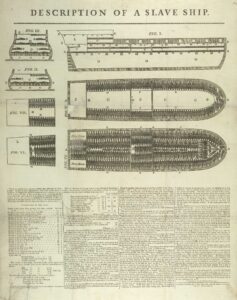
They put the Zong under the command of a man named Luke Collingwood. He was a ship’s surgeon by training, not a captain, his expertise was in pricing the enslaved, in judging what a body might fetch at marZong This was his first time in command of a vessel, and it showed. The ship took on far more people than it could safely carry: roughly 470 enslaved Africans, packed into a hold built for a fraction of that, watched over by just seventeen crew. The people in that hold had been bought along the Gold Coast, at fortresses like Cape Coast Castle and Anomabu, most of them likely Akan, taken from homes they would never see again. On the 6th of September 1781, the Zong turned its bow toward Jamaica.
A crossing that went wrong, and a mind that found an answer
Overcrowding does what overcrowding does. Disease moved through the hold and through the crew. By late November, sickness had already killed several of the seventeen sailors and around sixty of the captives. Then the navigation failed. Whoever was steering — Collingwood had fallen ill, and command had come apart — mistook the island, overshot Jamaica, and did not realize it until the ship was some three hundred miles past where it should have been. The story the crew would later tell was that the water was running out: only a few days’ supply left, and many more days of sailing ahead.
Hold that detail, because it is where the horror stops being an accident and becomes a decision.
Here is the arithmetic the Zong did. Under the insurance that covered ships like her, an enslaved person who sickened and died in the hold was simply a loss the owners had to swallow, you cannot insure against your cargo dying of natural causes any more than a farmer can insure a crop that rots. But maritime law had a doctrine called general average: if part of a cargo had to be deliberately sacrificed to save the rest of the ship, the insurers would pay for what was thrown away. Roughly thirty pounds for each person lost.
So the men of the Zong understood their situation with terrible clarity. If the Africans in the hold kept dying of thirst and fever, the owners got nothing. But if those same Africans were thrown into the sea, sacrificed, on paper, to preserve the voyage, the owners could collect. A death from disease was worthless. A death by drowning could be billed.
The killing
On the 29th of November 1781, the crew gathered and agreed to it. One of them, James Kelsall, would later claim he objected at first. It did not matter. The decision was made.
They began with the women and children. Around fifty-four of them were pushed through the cabin windows into the water. The next day, the 1st of December, forty-two men were thrown over the side. In the days that followed, thirty-six more. And ten people, having seen what was coming, having understood exactly what these careful men intended, chose the sea on their own terms and leapt, refusing to give the crew the satisfaction of the push. One person, impossibly, caught a rope and climbed back aboard.
By the end, at least 132 human beings had gone into the Atlantic. Some counts put it as high as 142.
And here is the fact that strips away any last defense: after the first people were drowned, it rained. The ship caught fresh water. The emergency the crew had named as their justification was over. And still they kept throwing people into the sea.
The Zong reached Black River, Jamaica, on the 22nd of December. Around two hundred and eight of the people who had left Africa were still alive. They were sold. Collingwood died soon after the ship made port. The ship’s log, the one record that might have told the whole truth, quietly disappeared.
The trial, where the real obscenity lives
If the story ended in the water, it would only be a massacre. What makes the Zong a thing we are still reckoning with is what happened next, in a courtroom, in daylight, among reasonable men.
The owners filed an insurance claim. They wanted their thirty pounds a head for the people they had drowned. The underwriter, a man named Thomas Gilbert, refused to pay — not because murder had been done, but because he suspected the loss was the crew’s own fault. He pointed out, among other things, that the ship had been found with some four hundred and twenty gallons of water aboard when she was inventoried in Jamaica. The “we had no choice” story did not hold.
A Jamaican court heard it in 1782 and the jury sided with the owners: pay the claim. The insurers appealed, and in 1783 the case crossed the ocean to England, to the King’s Bench, the highest court in the land. It is recorded as Gregson v Gilbert. The Lord Chief Justice himself, the Earl of Mansfield, presided.
Read the next sentence slowly. At no point was this a murder trial. From the Jamaican jury to the highest court in Britain, the Zong was argued as a dispute about cargo — about whether an insurer owed money for goods that had been thrown overboard. The hundred and thirty-two people were not victims in the eyes of that law. They were property, and the only open question was who absorbed the cost of their destruction. Mansfield set aside the first verdict and ordered a new trial, on the grounds that the crew’s own errors — and that rain — meant the killings might not qualify as a lawful sacrifice. There is no record the second trial ever happened; the owners are believed to have simply dropped the claim.
So the men who drowned 132 people did not collect their insurance. But understand what that “victory” was and was not. The law did not turn against them because they had committed murder. It turned against them because they had mismanaged the cargo. Even at its most just, the British legal system of 1783 could see negligence where we see slaughter. It could not see a crime against persons, because it did not believe persons had been in that hold at all.
When the campaigners pressed for actual murder charges, they were turned away. The Solicitor General reportedly scoffed at the very idea — what claim was this, that “human people” had been thrown overboard? It was a matter of goods, he said; the case was no different than if wood had been tossed into the sea. No member of the crew was ever prosecuted. No one was punished for the deaths of those 132 people. Not one.
Why we tell it, and why we keep the number
News of the case reached a formerly enslaved man named Olaudah Equiano, who by then was fighting in Britain to end the trade that had once held him. It was Equiano who carried the story to the abolitionist Granville Sharp. It was Sharp who first insisted on the word the law refused: massacre. He fought to have the crew tried for murder and lost. But the Zong did not stay buried. It became one of the cases that woke the British public, that drew in Thomas Clarkson and the others, that helped turn a trickle of conscience into the movement that would eventually break the trade.
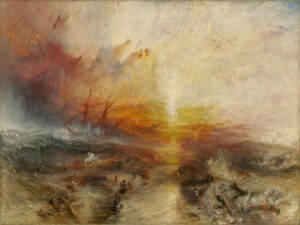
The painter Turner would later put a slave ship and a sea full of bodies on a canvas the world could not look away from. The Tobago-born poet M. NourbeSe Philip would take the dry language of the court record itself and break it apart into a book-length lament, refusing to let the legal words have the last word. The novelist Fred D’Aguiar would imagine a survivor who fought back. We have not let it go, because it tells us something we are not allowed to forget: that the plantation economy of our region did not require cruel men in every chair. It required only a system in which a human being could be property — and once that was true in law, everything else, even this, became merely a question of accounting.
Those people went into the sea off Jamaica. Into our water. We do not have their names — and that absence is its own part of the crime, because a name is the first thing a system like this destroys. So we hold the only thing the record left us. We say the number until it stops sounding like cargo and starts sounding like what it was.
One hundred and thirty-two.
SOURCES
Britannica, “Zong massacre” — date (29 Nov 1781 onward), “more than 130 enslaved Africans,” the lack of fresh water, the insurance claim, the appeal.
BlackPast.org, “The Zong Massacre (1781)” — departure 6 Sept 1781 with 470 enslaved Africans; Collingwood as surgeon/first command; 132 thrown over; the Solicitor General John Lee’s “as if wood” remark; Sharp and Equiano; no one brought to justice.
The London Museum and irise.uk — roughly 470 aboard; “for that was all the Zong affair was concerned with: insurance.”
Engole / Wikipedia, “Zong massacre” — Gregson v Gilbert (1783) 3 Doug. KB 232; the jury found for the slavers, Mansfield’s appeal court ruled against the owners on grounds of crew fault; Equiano informed Sharp.
Insurance Museum and Royal Gazette — the “general average” insurance mechanism; Gilbert’s 420-gallons rebuttal; rain falling before the final killings; Mansfield ordering a new trial; ~£30 per enslaved person; Sharp coining “massacre.”
African American Registry / “Hidden History” — the sequence (54 women and children, then 42 men, then 36 more), the ~10 who jumped, the one who climbed back, ~208 alive at Jamaica, arrival at Black River 22 Dec 1781.
Ownership: Liverpool syndicate associated with the Gregson family (former mayors of Liverpool); sources name William and James Gregson and co-owner George Case — kept general in the text to avoid a single-name error.
Legacy: J.M.W. Turner, The Slave Ship (1840); M. NourbeSe Philip, Zong!; Fred D’Aguiar, Feeding the Ghosts — standard literary record.
Editorial notes (no-flattening guardrails):
Total killed is cited as 132–142; the on-record figure for those thrown is 132. Use 132, note “as many as 142.”
Numbers aboard at departure vary by source (442–470); used “roughly 470” per BlackPast/Royal Gazette.
The appeal did not rule it murder — it turned on the crew’s negligence. This distinction is the heart of the story and must never be softened into “justice was done.”